Take2Me: a custom food delivery platform, from code to cloud
Client:Take2Me - Alcor S.r.l. (Rimini, Italy)Year:2024
- Laravel
- PHP
- MySQL
- Redis
- Google Cloud
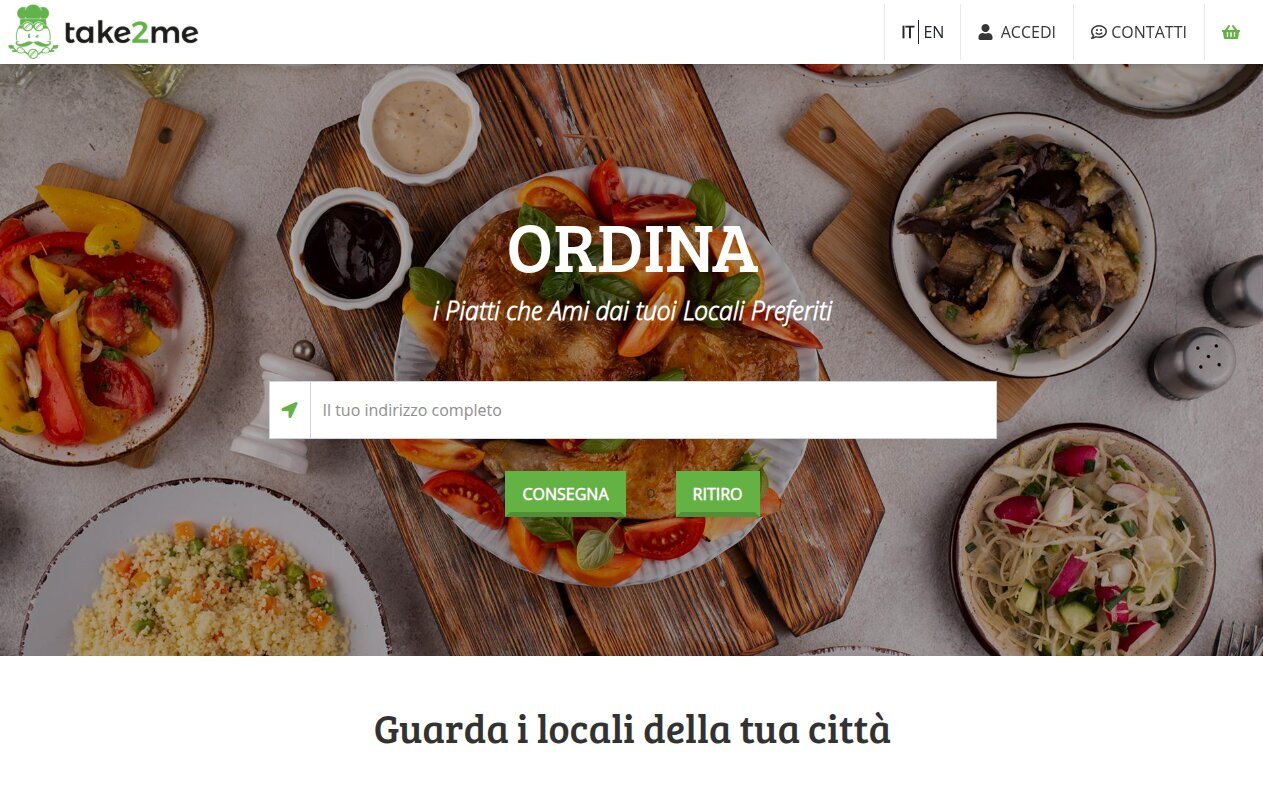
Take2Me is the delivery and takeaway platform connecting restaurants, pizzerias and customers across Italy's Romagna Riviera and the Marche region - from Rimini and Riccione to Misano, Cattolica, Pesaro and Urbino. A local platform with its own brand, alongside the big delivery apps.
init.d built the platform end-to-end and manages its infrastructure:
- Laravel/PHP backend: venue catalogue, menus, cart and orders with delivery or pickup.
- Dedicated areas for partner restaurants and riders, with real-time order management.
- Venue search by city and cuisine (pizza, piadina, sushi, burgers), built for local SEO.
- Infrastructure on Google Cloud sized to handle dinner-time peaks.
- Ongoing system administration: monitoring, tested backups and security updates.
How does a food delivery platform work?
It connects three parties, each with its own interface: the person ordering, the venue preparing the food and the rider delivering it. The customer picks a city or address, browses the available venues, fills the cart and chooses between home delivery and pickup. The restaurant receives the order in its own area, confirms it and prepares it; the rider takes it on and brings it to its destination. Behind this flow there are rules the platform must apply consistently: venue opening hours, delivery zones, dish availability, order statuses that move forward step by step. Designing a system like this is above all about modelling these statuses and the hand-offs between parties well, because every order must have a clear status for everyone at all times.
How do you handle dinner-time peaks?
By preparing the application and the infrastructure to receive many requests concentrated in a short time. In food delivery, traffic is not spread over the day: it clusters around lunch and above all dinner, and at weekends. The stack includes Redis, which in a Laravel application usually serves as cache, session store and job queue: the most frequently read information, such as venue lists and menus, is served from memory instead of querying the database every time, and tasks that must not hold up the person ordering, such as sending notifications and emails, run in a queue. On the infrastructure side, on Google Cloud resources are sized for the busiest moments, and monitoring keeps an eye on response times and errors precisely in the time slots that matter.
Why does local SEO matter for delivery?
Because people ordering almost always look for a type of food in a specific place, with searches such as "pizza delivery" followed by the city name. A platform that wants to be found needs dedicated pages by city and by cuisine, with useful content and a structure search engines can read easily. That is why we designed venue search so that combinations of city and cuisine correspond to reachable pages, with titles and text consistent with what people search for. It is site architecture work even before content: readable page addresses, sensible internal links, and fast loading even on phones, the device people most often order from.
Why development and infrastructure with the same team?
Because in a platform that works in real time, code and servers are tightly linked. A new feature can change the database load, a PHP or Laravel update has to be tested together with the server configuration, and a slowdown is diagnosed faster when whoever reads the logs also knows the code. By looking after both layers we schedule releases and updates in low-traffic windows, verify backups with restore tests and apply security updates regularly. We describe this way of working on the custom software and cloud pages.
The result is a local food delivery platform with its own brand, independent from the big platforms. init.d handles both software development and server management: a single point of contact from commit to production.